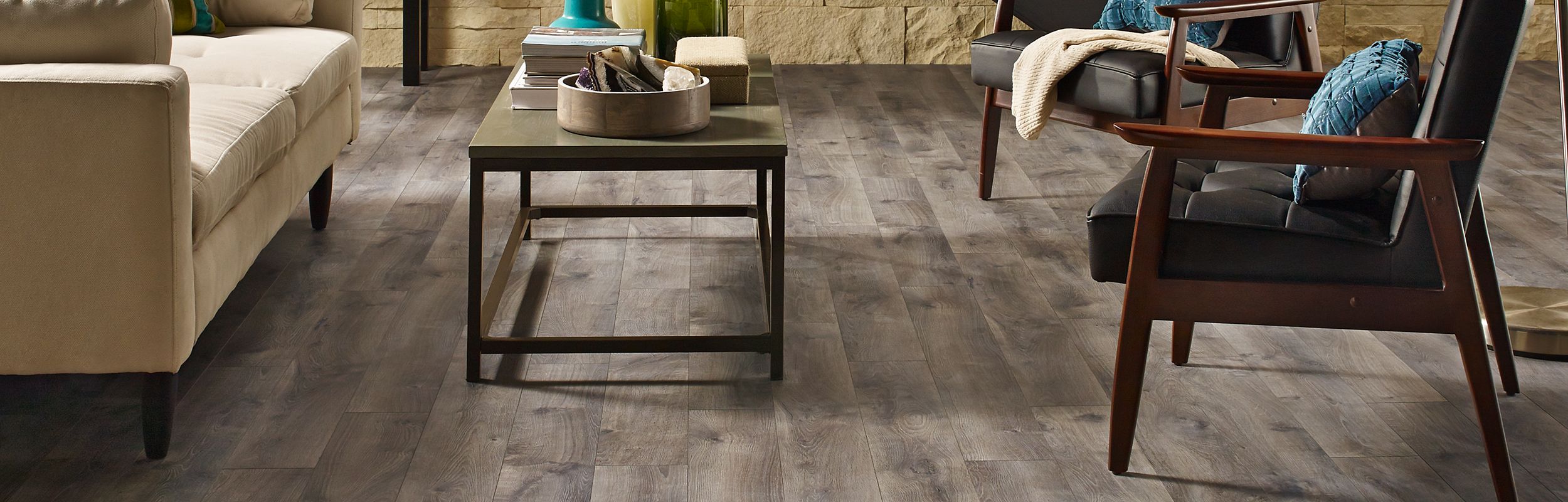
Installing Floor Tile
Looking to install Wall & Countertop tile?
Click here
Step 1: Surface Preparation
Tile may be installed over most structurally sound substrates, if they are clean,
smooth, dry and free of wax, soap scum and grease. Any damaged, loose or uneven
areas must be repaired, patched and leveled. Remove any moldings, trim, appliances,
etc., which could interfere with installation. Door jambs may be undercut for tile
to slip under.
Step 2: Layout
Begin by marking the center point of all four walls. Snap chalk lines between the
center points of opposite walls, which will intersect at the center of room. Make
sure they're perfectly square, and adjust if necessary. Next, lay out a row of loose
tiles along the center lines in both directions, leaving spaces for uniform joints
(use tile spacers). If this layout leaves cuts smaller than 1/2 tile at walls, adjust
the center line by snapping a new line 1/2 tile closer to the wall. Repeat along
other center line if necessary. Now divide the room into smaller grids (approx.
2' x 3') by snapping additional lines parallel to center lines.
Step 3: Applying Adhesive
Select the right adhesive for the substrate you're using. Carefully read and follow
all instructions and precautions on the adhesive or mortar package. Mix only enough
to be used within 30 minutes. Using the type trowel recommended on the adhesive
package, spread a 1/4" coat on the surface of one grid area, using the flat
side of the trowel. Do not cover guidelines. Next, use the notched side of trowel
to comb adhesive into standing ridges by holding trowel at a 45-degree angle. Then
remove excess adhesive, leaving a uniform, ridged setting bed. Don't spread a larger
area than can be set in 15 minutes.
Step 4: Cutting Tile
Measure tiles to be cut carefully and mark with a pencil or felt-tip pen. Make straight
or diagonal cuts with a tile cutter, curved cuts with a nipper (chipping away small
pieces for best results), full-length curved cuts with a rod saw. Sharp-cut edges
may be smoothed with a carborundum stone.
Step 5: Setting Tile
Variation of shades is an inherent characteristic of ceramic tile -- mix tiles from
several cartons as you set, for a blended effect. Begin installing tiles in the
center of the room, one grid at a time. Finish each grid before moving to the next.
Start with the first tile in the corner of the grid and work outward. Set tiles
one at a time using a slight twisting motion. Don't slide tiles into place. Insert
tile spacers as each tile is set, or leave equal joints between tiles. Fit perimeter
tiles in each grid last, leaving 1/4" gap between tile and wall. When grid
is completely installed, tap in all tiles with a rubber mallet or hammer and wood
block, to ensure a good bond and level plane. Remove excess adhesive from joints
with a putty knife, and from tile with a damp sponge. Do not walk on tiles until
they are set (usually in 24 hours).
Step 6: Grouting Joints
Generally, you should wait about 24 hours before grouting (refer to the adhesive
package for specifics). Carefully read and follow all instructions and precautions
on the grout package. Make only enough to use in about 30 minutes. Remove tile spacers
and spread grout on the tile surface, forcing down into joints with a rubber grout
float or squeegee. Tilt the float at a 45-degree angle. Remove excess grout from
surface immediately with the edge of float. Tilt it at a 90-degree angle and scrape
it diagonally across tiles. Wait 15-20 minutes for grout to set slightly, then use
a damp sponge to clean grout residue from surface and smooth the grout joints. Rinse
sponge frequently and change water as needed. Let dry until grout is hard and haze
forms on tile surface, then polish with a soft cloth. Rinse again with sponge and
clean water if necessary. Wait 72 hours for heavy use. Don't apply sealers or polishes
for three weeks, and then only in accordance with manufacturer's recommendations.
Looking to install Wall & Countertop tile?
Click here